
Blog Category: Use Cases (5 posts)
How Cadence's AI scheduling actually works (and where it doesn't)
Cadence | 23rd July 2026 |
General Articles
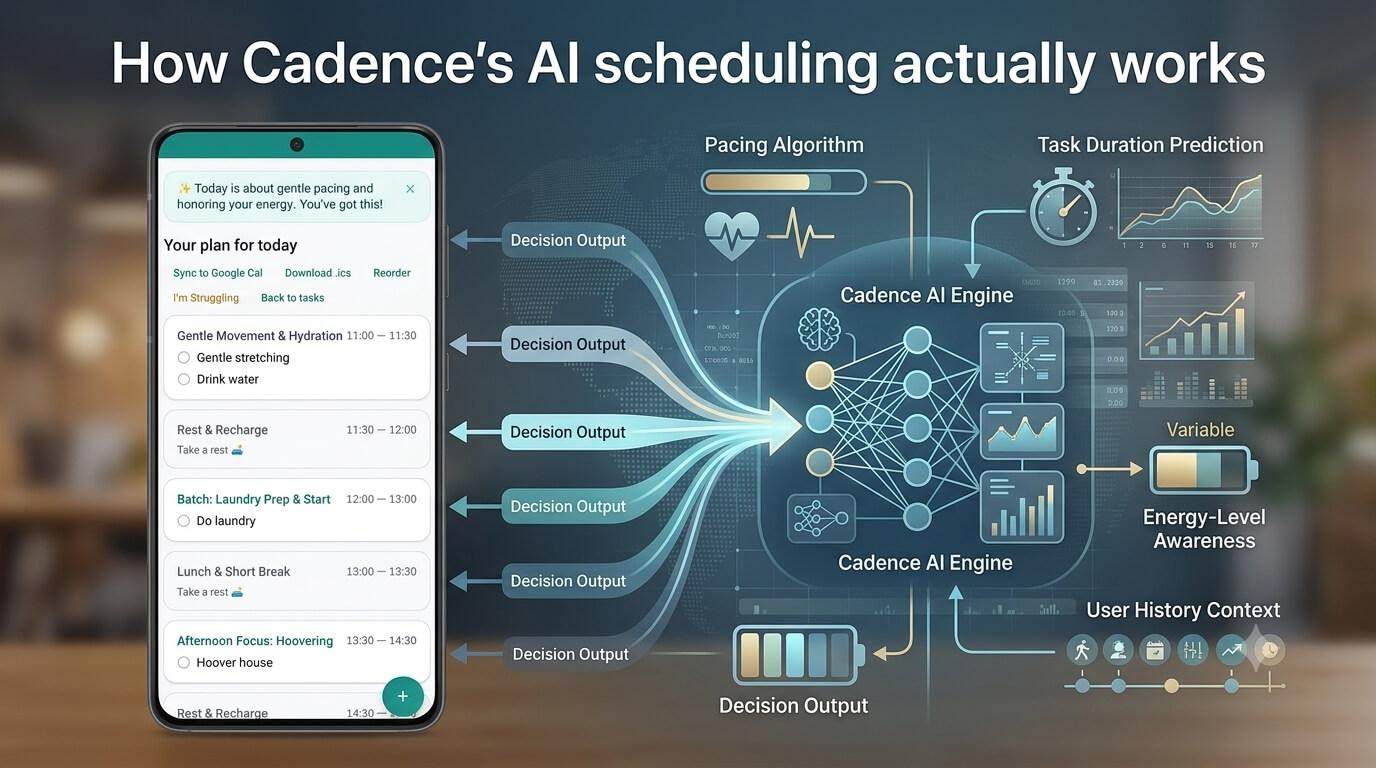
A lot of "AI-powered" planning apps amount to a thin wrapper around a chatbot that's been told to "be helpful and encouraging." You ask it to plan your day, and it gives you a list that looks plausible but ignores the fact that your dentist appointment is fixed at 2pm, or schedules four "deep focus" blocks back to back like that's a thing a human can do.
Cadence uses Gemini to build your day plan too — but getting it to behave took more work than just writing a friendly prompt.
The problem with "just ask nicely"
Early versions of the scheduling prompt buried constraints in regular sentences — "please try to keep fixed appointments where they are" mixed in with a dozen other instructions. The model would routinely ignore it. Not maliciously, just... it's a lot of text, and soft instructions get lost in soft instructions.
What actually works: shouting (politely) in headers
The fix turned out to be structural, not tonal. Breaking the prompt into clearly named, ALL-CAPS sections — FIXED TIME CONSTRAINTS, PRIORITY RULES, TASK NAMES — made an enormous difference to how reliably the model respects them. It's a bit like the difference between mentioning something in passing during a meeting versus putting it on a slide with a heading. Same information, very different chance of it landing.
What goes into the plan
When Cadence builds your day, it's pulling from several layers:
Your profile — energy and focus peak times, whether you need regular breaks (and how long), hard limits you've set, and a free-text "Your situation" field where you can describe what's actually going on: conditions, circumstances, anything the AI should know that doesn't fit in a dropdown. This is passed anonymously to the model when building your plan; it's never stored on the servers.
Today's check-in — your energy and/or focus level right now, what time you're available from and until, and whether to plan from the current moment or lay out the full day from the start.
Your tasks...
Daily planning with fibromyalgia: an app that actually gets it
Cadence | 14th June 2026 |
General Articles
Planning with fibromyalgia is its own particular challenge. You can't predict good days and bad days in advance. You can't commit to a fixed schedule and expect to stick to it. And most apps, however well-designed, were built by people who've never had to weigh up whether a shower counts as a task.
Cadence was built by someone with fibromyalgia, for exactly this.
The core difference
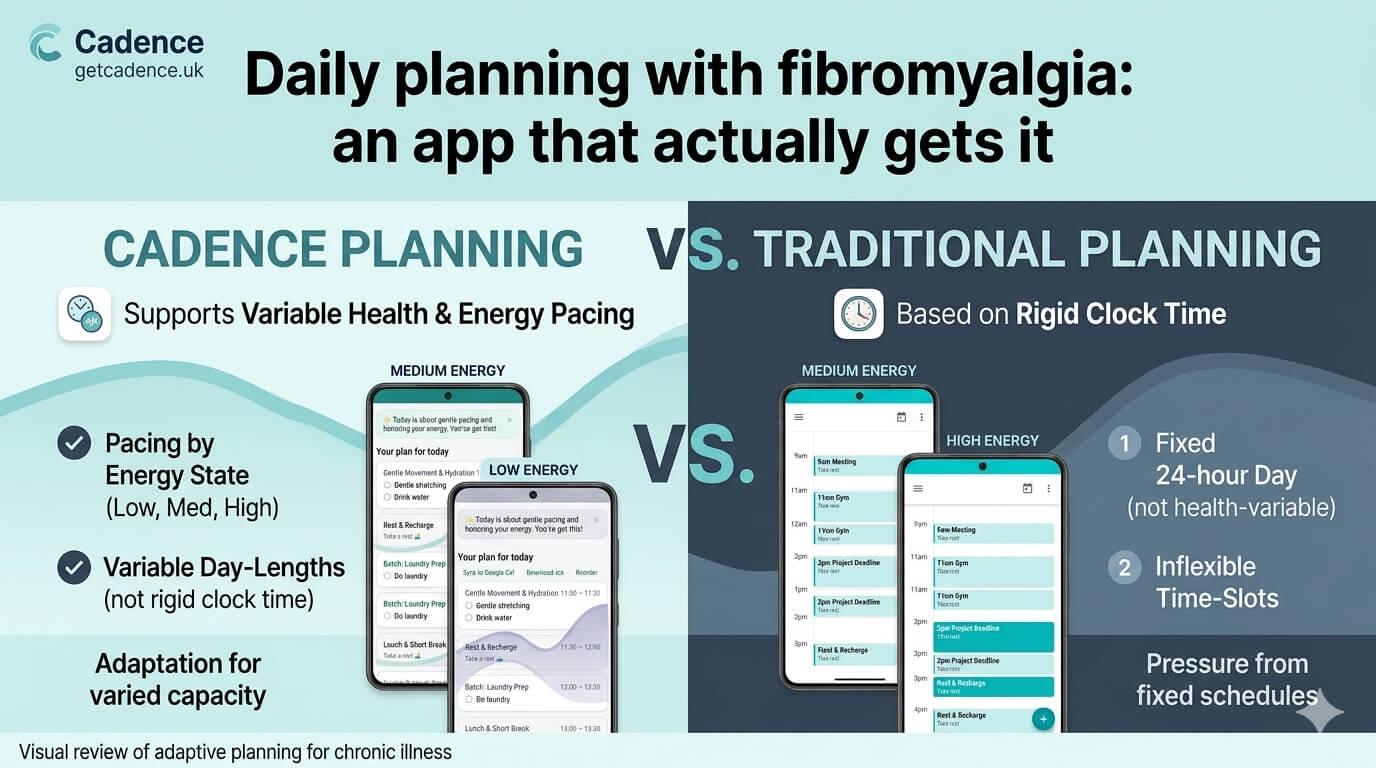
Cadence doesn't ask you to plan tomorrow based on how you hope to feel. It asks how you're doing right now. When you plan your day, it checks in on energy and focus, adjusts for how much time you have available, and builds a realistic plan from your actual task list.
There's no fixed daily schedule to fall behind on. No streak to break. No notification telling you you've missed something you'd already written off at 8am.
When the day doesn't go to plan
There's a mid-day reschedule built in. If a flare hits mid-morning, you can tell Cadence and it'll rebuild what's left around your current capacity. Tasks that don't happen roll over to the next day.
Privacy
Cadence is designed with privacy as a priority. Your data stays yours. There's no advertising layer. The AI planning is powered by your inputs — not by selling your health data.
Pricing
Free to use, including AI planning. Pro is £5.99/month for Google Calendar sync, cross-device sync, and Ask Cadence AI chat. No card required.
👉 Get Cadence today...
A daily planner for low energy days — not just good ones
Cadence | 14th June 2026 |
General Articles
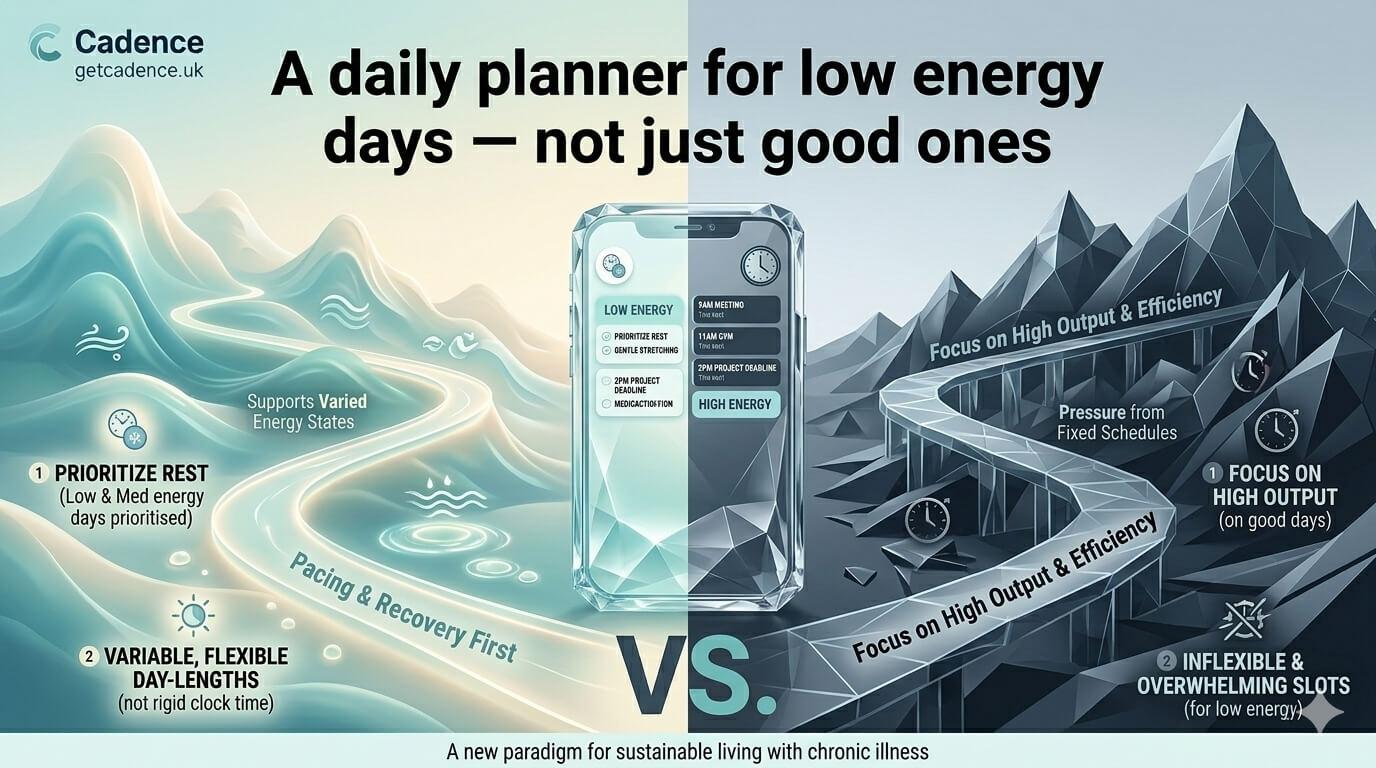
Most productivity apps have an implicit target user: someone with consistent energy, reliable focus, and enough capacity to follow a schedule they set the day before.
If that's not you, most apps will just make you feel worse about it.
Cadence is built for the other days. The slow starts. The mid-afternoon crashes. The days where you have two hours and need to make them count.
What makes it different
Before you build your day, Cadence asks how your energy and focus are sitting. It then plans around that — pulling from your task list and matching tasks to what you've actually got. If you're operating at low capacity, it'll prioritise accordingly.
Mid-day reschedule is built in. If energy drops further, or something takes longer than expected, you can reset your plan from wherever you are without losing what's already been done.
No guilt architecture
Tasks that don't get done roll over. There are no streaks to protect. No daily score. No app notifications implying you could have done more.
Just a plan that works with your energy instead of against it.
Pricing
Free tier includes AI planning, task rollover, and push notifications. Pro (£5.99/month) adds Google Calendar sync, cross-device sync, and the Ask Cadence AI chat. No card required to start.
👉 Get Cadence today...
A free daily planner built for chronic illness — that actually adapts to your energy
Cadence | 14th June 2026 |
General Articles
Most productivity apps are built on an assumption so obvious nobody says it out loud: that you'll have roughly the same capacity every day.
For people with chronic illness, that assumption invalidates most of the tools before they're even opened. An app that tells you to follow the same schedule regardless of how you're feeling isn't a planning tool — it's a daily reminder of the gap between what you intended and what your body allowed.
Cadence was built specifically to close that gap.
How it works
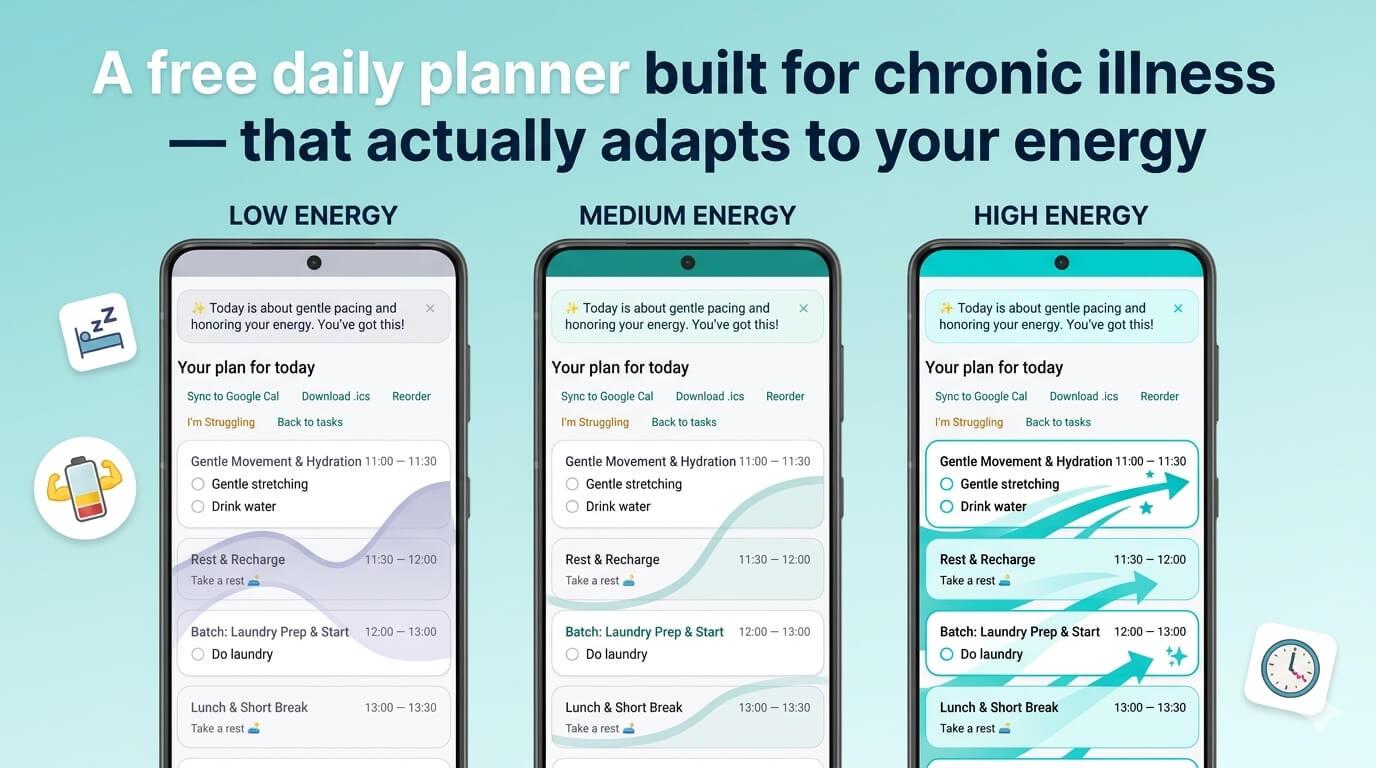
Each morning, Cadence asks how your energy and focus are doing. When you're ready to plan your day with AI, it also asks how much time you have available. Then it builds your day from your task list based on those answers — not from a fixed schedule or an idealised version of you.
Low energy day? It plans accordingly. If you tell it you've got a couple of hours and your energy is at the floor, it won't serve you five demanding tasks and expect you to get through them.
Mid-day adaptability
If things change — and with chronic illness, they usually do — there's a mid-day reschedule option. You tell Cadence things have shifted, it rebuilds the rest of your day from where you actually are. Nothing gets lost. Tasks roll over automatically.
What it doesn't do
Cadence won't cure your bad days or pretend they don't exist. It won't give you a motivational speech. It'll just help you figure out what's actually possible with what you've got — and make sure the things that matter most are accounted for.
Pricing
Free tier includes AI-powered daily planning, task management, and rollover. Pro (£5.99/month) adds Google Calendar sync, cross-device sync, and the Ask Cadence AI chat. No card required to start.
👉 Get Cadence today...
A free daily planner for ADHD that adjusts to how you're actually feeling
Cadence | 06th June 2026 |
General Articles
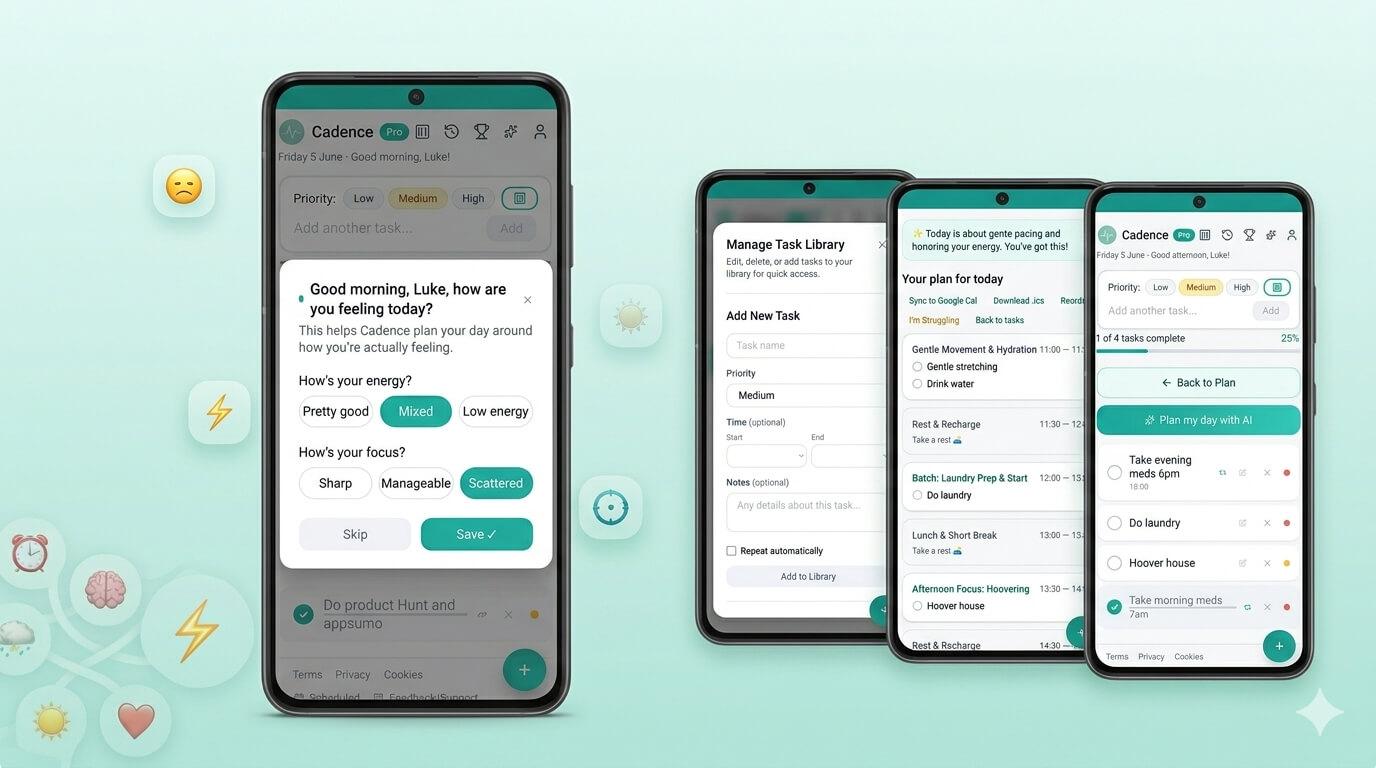
Most productivity apps were designed by people who don't have ADHD, for people who don't have ADHD. The result is usually a long list of tasks, a calendar with time blocks, and a quiet implication that if you just stuck to the plan, everything would be fine.
If you have ADHD, you already know the problem with that. The plan made sense yesterday. Today your focus is scattered, you've already spent an hour on something that wasn't on the list, and the whole schedule feels like evidence of failure rather than a useful tool.
Cadence works differently.
It starts with how you're doing today
Every morning, Cadence asks you three questions: how's your energy, how's your focus, and how much time do you actually have. Then it builds your day from your task list based on those answers — not based on some ideal version of you that exists only on good days.
High energy and good focus? It'll suggest your heavier tasks. Scattered and low? It'll give you something manageable and protect your limited capacity.
It rolls with you, not against you
ADHD days rarely go to plan. Cadence has a mid-day reschedule built in — you can tell it things have gone sideways and it'll rebuild the rest of your day from where you actually are, not where you were supposed to be.
Tasks that don't get done roll over automatically. Nothing disappears into the void.
What it doesn't do
Cadence isn't a project manager. It won't handle complex workflows or team collaboration. It's a daily planner — specifically for people who struggle with the daily part.
Pricing
Free tier includes AI-powered daily planning, task management, rollover, and push notifications. Pro (£5.99/month) adds Google Calendar sync, cross-device sync, and the Ask Cadence AI chat.
No trial period that expires. The free version is actually free.
👉 Get Cadence today....